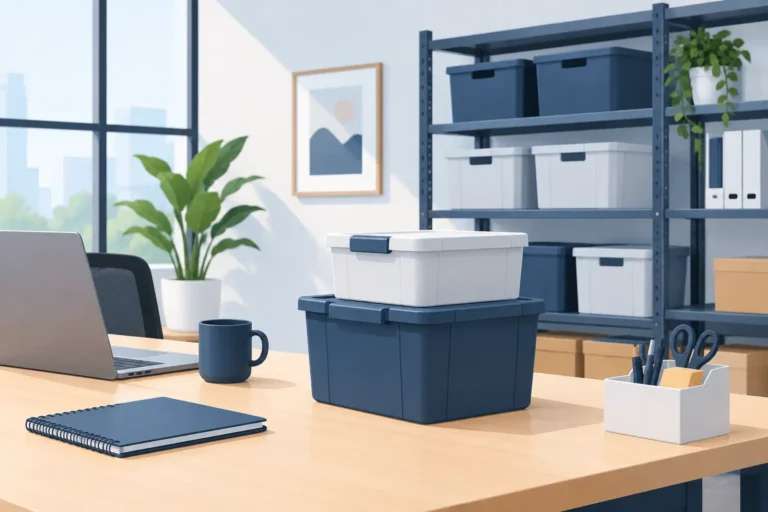

A crowded stockroom does more than make receiving difficult. It slows staff down, hides profitable items, creates safety risks, and can take space away from displays that actually generate sales. The best retailer inventory storage ideas solve the immediate overflow problem while giving your team a clearer, faster way to handle stock.
For independent retailers and growing businesses, the right answer is rarely a larger permanent warehouse. Demand changes, seasonal lines arrive in waves, and retail space is expensive. A practical storage plan should expand when required, stay close to the point of sale, and avoid adding unnecessary handling to every box.
Retailer Inventory Storage Ideas for Better Daily Flow
1. Keep fast-selling stock closest to the sales floor
Start with the items your team replenishes most often. These products should be easy to reach, clearly labelled, and stored at a safe working height. If staff must dig behind slow-selling cartons to find everyday stock, the system is working against them.
Use a simple A-B-C approach. A items are frequent sellers and belong closest to the access point. B items can sit a little farther back. C items, including discontinued lines and low-volume supplies, can take the least convenient positions. Review these categories regularly, especially after a promotion or seasonal change.
2. Create a dedicated receiving and sorting zone
New deliveries often cause the most disorder because staff need somewhere to count, inspect, label, and sort cartons before putting them away. Without a defined zone, incoming stock lands in aisles, near exits, or directly on the sales floor.
Set aside an area for receiving that has enough room for a cart, paperwork, packing material, and a temporary stack of cartons. The goal is not to keep inventory there. It is to prevent unfinished receiving work from spreading through the store. Even a small operation benefits from a clear rule: goods are checked first, then assigned to a storage location.
3. Use portable storage for seasonal overflow
Seasonal inventory can be difficult to justify inside a retail unit months before it is needed. Holiday merchandise, patio products, school-related goods, or special-event stock can consume valuable space long before customers are ready to buy it.
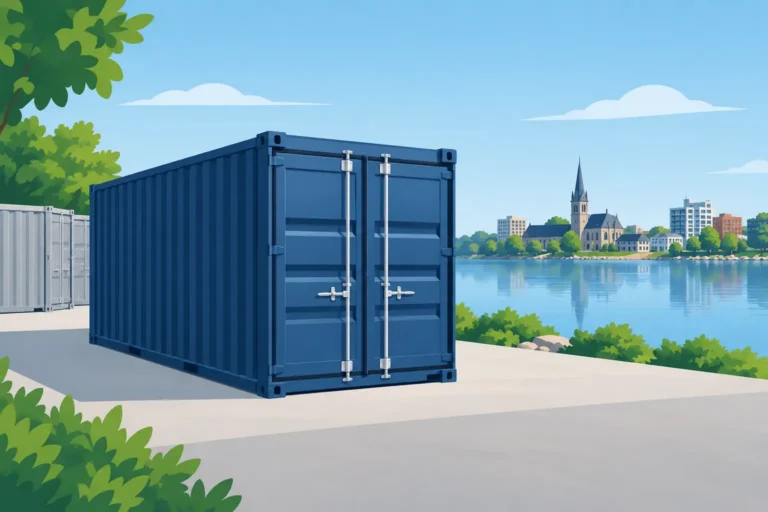
A portable storage unit placed at your location provides nearby overflow capacity without requiring staff to transport stock across town. It can be especially useful for retailers in Kingston and across Eastern Ontario that need extra room for a defined season but do not want to commit to a larger commercial lease. Keep an inventory map of what is inside, and place the earliest-needed cartons nearest the door.
4. Store by collection, not just by carton size
Stacking the smallest cartons together may look neat, but it often makes replenishment slower. Where possible, store related products together: one collection, supplier, department, or campaign at a time. This lets staff pull a complete set of items without searching several locations.
There are exceptions. Heavy items belong low, and fragile goods need stable shelving or careful stacking regardless of category. The point is to balance physical safety with retrieval speed. A storage layout that looks efficient but requires ten minutes of searching for one product is not efficient in practice.
5. Make every location easy to identify
Inventory errors frequently come from vague labels such as “back shelf” or “storage area.” Give each shelf, rack bay, pallet position, or container section a simple location code. For example, use A1, A2, and A3 for one shelving run, then B1, B2, and B3 for the next.
Match those codes to your point-of-sale system, inventory spreadsheet, or receiving log. A basic system is enough if it is used consistently. Staff should be able to answer two questions immediately: how many units are on hand, and exactly where are they stored?
6. Build replenishment levels into the system
Retail storage should support the sales floor, not become a separate pile of unknown stock. Set a minimum display quantity for core products. When the display reaches that level, staff know it is time to replenish from the back room or on-site storage unit.
This approach reduces rushed searches during busy hours and helps maintain a full-looking store. It also reveals when the problem is not storage capacity but ordering. If the same product regularly runs out before replacement stock arrives, adjust purchasing timing rather than simply finding more room for empty cartons.
7. Use vertical space safely
Many retailers have unused height in their stock areas. Shelving, racking, and labelled bins can increase capacity significantly, provided they are installed correctly and staff can access them safely. Keep heavier cartons on lower shelves, avoid overloading racks, and leave clear aisles for carts and people.
Do not stack boxes so high that they are difficult to inspect or retrieve. A few extra cartons on top are not worth an injury or damaged inventory. If storage space has become a daily safety concern, that is a strong sign that overflow stock needs a separate location.
8. Separate sellable stock from supplies and returns
Cleaning products, fixtures, bags, signage, returns, damaged goods, and staff supplies can quietly take over inventory space. They need storage too, but they should not be mixed with sellable merchandise.
Create distinct zones and labels for these categories. Returns should be processed quickly, with a clear decision on whether they can be resold, sent back to a supplier, or disposed of. Keeping them separate gives you a more accurate picture of what inventory is actually available for customers.
9. Protect stock from moisture, temperature, and pests
Not all inventory has the same storage requirements. Paper goods, textiles, electronics, food products, cosmetics, and certain adhesives can be affected by heat, cold, humidity, or pests. Before placing goods in any storage area, confirm the conditions are appropriate for the product and its packaging.
Keep cartons off the floor on pallets or shelving where practical, particularly in areas that may be exposed to dampness. Leave enough space to inspect walls and corners, and avoid packing stock so tightly that leaks or pest activity go unnoticed. Portable storage works well for many dry, securely packaged retail goods, but sensitive inventory may require climate-controlled conditions instead.
10. Plan for access, not just capacity
The biggest storage unit is not automatically the best choice. Consider who needs access, how often stock is retrieved, where delivery vehicles can stop, and whether carts can travel safely between storage and the sales floor. A unit placed close to the business can reduce handling time, but it still needs a clear, safe path for staff.
For short-term peaks or renovation-related disruption, portable storage can provide useful breathing room at the property. GoBox Portable Storage delivers secure units directly to commercial locations, allowing retailers to keep appropriate inventory nearby while maintaining more usable space inside.
A Storage Plan Should Change With Your Sales Cycle
Review storage at least before each major seasonal shift and after any significant supplier change. Look for cartons that have not been touched, products that are repeatedly hard to find, and areas where staff are creating temporary piles because the assigned location no longer works. Those small signals usually appear before storage becomes a larger operational problem.
Keep the plan simple enough that every staff member can follow it on a busy day. When stock is labelled, protected, and stored close to where it is needed, your team spends less time handling boxes and more time helping customers. If your retail space needs room to perform, bringing storage to your location can be a practical next step.