
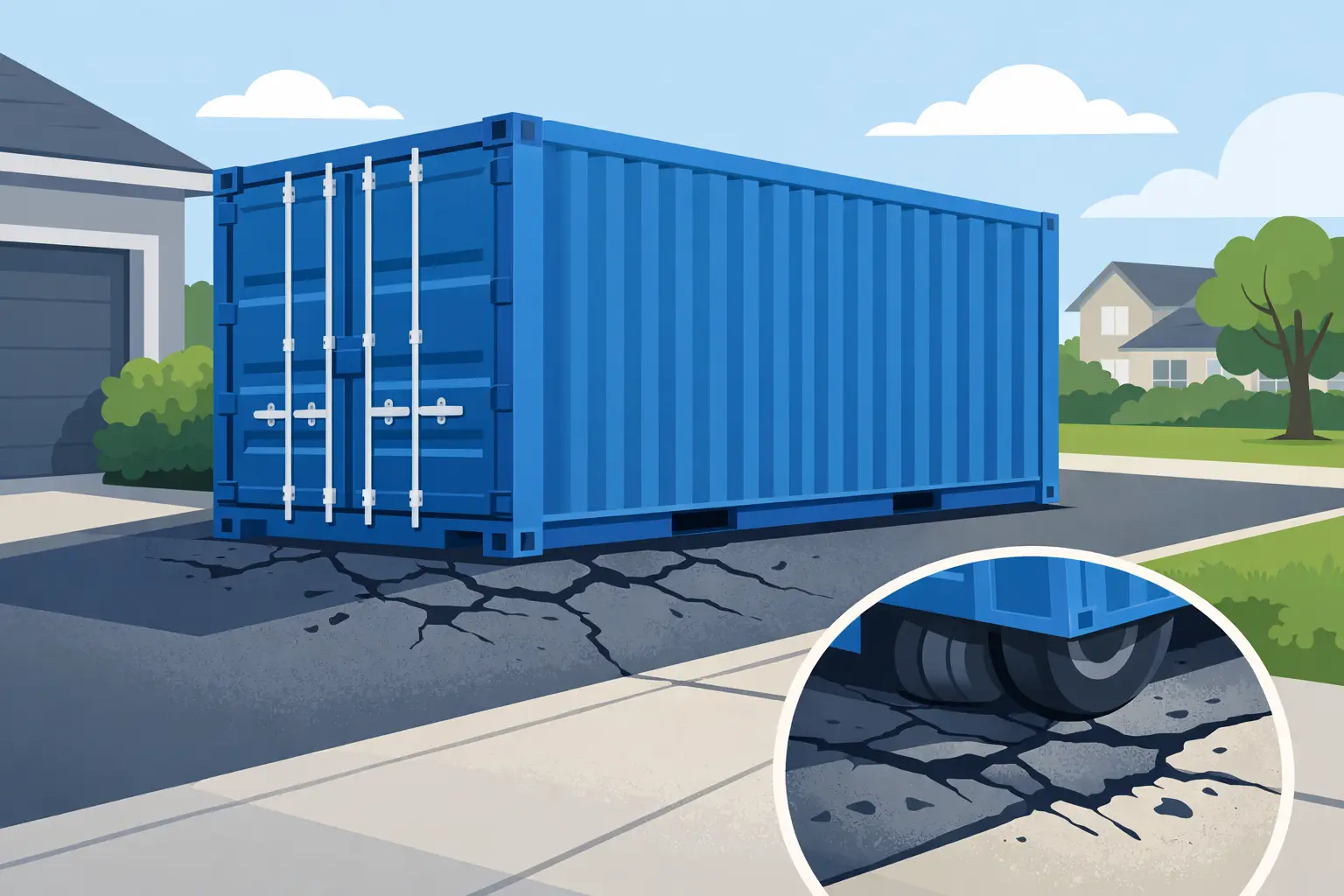
A storage container can be a practical way to keep belongings, tools, materials, or inventory close at hand. But can storage containers damage driveways? They can, particularly when a driveway is already weak, soft, uneven, or not built for concentrated weight. The good news is that careful planning and clear information before delivery can greatly reduce the risk.
A portable storage container does not place weight on a driveway in the same way as a parked passenger vehicle. Its weight is concentrated at key contact points, and delivery equipment adds another consideration. The driveway surface, the ground below it, the season, the container size, and how long it remains in place all matter.
Can Storage Containers Damage Driveways?
There is no one answer for every property. A sound, properly cured concrete or asphalt driveway may support a container without an issue, while an older surface with cracks, thin edges, soft sub-base material, or drainage problems may be more vulnerable.
Damage can range from small scuffs and impressions to cracking, rutting, settling, or broken edges. Asphalt is generally more susceptible to dents and depressions in hot weather. Concrete can crack if it has existing weaknesses or if weight is placed too close to an unsupported edge. Interlocking stone can shift if the bedding layer or base beneath it is not well compacted.
The condition beneath the visible surface is just as relevant as the surface itself. A driveway can look solid from above yet have poor drainage or a soft base below. When heavy rain, spring thaw, or repeated freeze-thaw cycles affect the ground, its ability to support concentrated weight can change quickly. That is a familiar concern for property owners across Eastern Ontario.
What Creates the Greatest Risk?
Container weight is the starting point. Even an empty steel storage unit weighs several thousand pounds. Once filled with household contents, construction supplies, equipment, or business inventory, the total weight increases substantially. The load inside also matters. A container packed evenly creates a more predictable load than one with most heavy items concentrated at one end.
Placement is equally important. The corners and edges of a driveway are usually more vulnerable than the central section because they may not have the same support underneath. A container should not be placed where its weight bears on a crumbling edge, a recently repaired area, a utility cover, or an obvious low spot where water collects.
Delivery conditions deserve attention as well. The truck and equipment used to position a container have their own weight and need enough room to access the site safely. Narrow driveways, sharp turns, steep grades, low branches, and soft shoulders can limit suitable placement options. A clear, level approach helps the delivery proceed safely and helps protect the property.
Weather can change the equation. Fresh asphalt is especially vulnerable, and asphalt can soften during prolonged summer heat. A driveway that is firm during a dry August week may be less stable during spring thaw or after heavy rainfall. Frozen ground is not automatically a guarantee of support either, especially when temperatures fluctuate and moisture sits beneath the surface.
Driveway Materials and Their Considerations
Concrete is often the most durable driveway material, but it is not immune to damage. Existing hairline cracks, settling slabs, spalled areas, and weak edges can worsen under concentrated weight. Newly poured concrete needs adequate curing time before carrying a heavy container. If there is any doubt about its age or condition, it is better to discuss the surface before arranging delivery.
Asphalt has more flexibility than concrete, but that flexibility can become a weakness under concentrated loads. Warm asphalt can develop marks or depressions, particularly where the base below is thin or poorly compacted. Older asphalt with alligator cracking, potholes, or soft sections is a warning sign that another placement area may be preferable.
Interlocking stone and gravel driveways depend heavily on their base. Well-installed pavers may handle a container well, but loose, uneven, or shifting stones may settle under the load. Gravel can provide a suitable area when it has a firm, compacted base, but loose gravel alone does not distribute weight evenly.
How to Prepare Before Delivery
Start by looking closely at the proposed placement area. Check for cracks, sinking, crumbled edges, standing water, uneven grade, and recent repairs. Consider where the container corners will rest, not just whether the centre of the driveway looks clear.
Measure the access route and placement space. Account for the container, the delivery truck, clearance for positioning equipment, and any obstacles such as gates, overhead wires, tree limbs, parked vehicles, or fencing. Do not assume a driveway that accommodates a car will automatically accommodate a delivery vehicle and a portable storage unit.
It is also wise to identify underground and surface features. Septic components, drainage structures, irrigation lines, utility covers, and culverts should not be subjected to unexpected loads. If the driveway crosses a culvert or has a visible soft section, share that information in advance.
Protective materials may help in some situations. Properly sized wood blocking or other load-distribution supports can reduce direct pressure at contact points and create a small separation between the container and the surface. These supports must be stable, level, and suitable for the weight involved. They are not a cure for an unstable driveway, but they can be useful on an otherwise sound surface.
Avoid placing scrap lumber, loose plywood, patio blocks, or improvised materials under a container without guidance. Materials that crack, shift, or sink can create an uneven base and may make the container harder to access safely.
When Another Location Is the Better Choice
Sometimes the best protection for a driveway is selecting a different placement area. A level, compacted gravel pad or firm section of property may be better suited than a driveway with visible deterioration. The alternative still needs clear access, stable ground, and enough room for safe delivery and use.
Be realistic about the length of the rental. A container kept on site for a brief project may present a different level of concern than one remaining through a full season of rain, heat, snow, and thaw. Long-term placement makes drainage, settling, and seasonal surface changes more relevant.
For commercial and industrial sites, speak with the person responsible for site operations or property maintenance. Paved yards, loading areas, and service lanes often have varying load capacities, even when they appear similar. A container should not block fire routes, access lanes, entrances, or routine deliveries.
A Better Delivery Conversation Starts Early
The most useful step is to describe the driveway honestly when requesting a storage quote. Mention the material, slope, width, access restrictions, recent paving, known cracks, and any concerns about soft ground. Photos can also help a provider assess the situation before arrival.
A local portable storage provider should be able to discuss access requirements and help determine whether the proposed location is appropriate. GoBox Portable Storage works with customers across Eastern Ontario to plan practical on-site storage placement based on real property conditions, not assumptions.
A driveway does not need to be perfect to support a storage container, but it does need to be assessed with the container, delivery method, and season in mind. A few minutes spent checking the surface and discussing the site can protect your property and help ensure storage is placed where it will work best.